Have you ever seen someone in a family group chat bragging about doubling their money with Bitcoin and felt that nagging curiosity? Or maybe an Instagram ad popped up promising a guaranteed 30% return on crypto and you almost clicked? Yeah, that happens. Cryptocurrency has become everyday dinner table conversation, but most people still have no idea where to actually start. This guide is for anyone who wants to understand the basics, take that first step safely, and — most importantly — avoid getting burned.
So, what exactly is cryptocurrency?
Cryptocurrency is a type of digital money that exists only online and isn't controlled by any bank or government. Think of it this way: the US dollar is issued by the Federal Reserve. Bitcoin, the most well-known cryptocurrency, is issued by an automated network of computers spread across the entire globe. Nobody's in charge of it.
The word "crypto" comes from cryptography, the security technology that protects every transaction. Every movement is recorded on a public database called the blockchain, which works like a massive ledger that anyone can view but nobody can erase or forge. It's different from a bank transfer, which runs through a bank's system and can be reversed.
There are thousands of cryptocurrencies out there. Bitcoin (BTC) and Ethereum (ETH) are the most well-known and most established. Then you have others like Solana, BNB, and the infamous meme coins — currencies created around internet memes or jokes. Dogecoin and Shiba Inu are the classic examples. They can shoot up in value, but they can also go to zero overnight. Spoiler: if you're a beginner, don't start with meme coins.
You don't need to buy a whole Bitcoin
This is the biggest myth that keeps people out. A single Bitcoin today costs tens of thousands of dollars, so a lot of people assume they need a fortune just to get in. You don't. You can buy an incredibly small fraction of Bitcoin — like 0.001 BTC or even less. On most exchanges (the platforms where you buy crypto), you can start with as little as a few dollars.
The smallest unit of Bitcoin is called a Satoshi, named after the anonymous creator of the currency. One Bitcoin equals 100 million Satoshis. So even with a small amount of money, you're already in the game. That doesn't mean you're going to get rich quick. It just means the barrier to entry is a lot lower than it looks.
How to buy your first fraction: step by step
Before you start buying, you'll need an account on an exchange — basically a cryptocurrency brokerage. Some of the most reputable and widely used options include Coinbase, Kraken, and Gemini. If you already use a traditional investment app, platforms like Robinhood and PayPal also let you buy crypto directly.
- Choose a well-known exchange. Google the name along with words like "scam" or "complaints." If a lot of problems come up, walk away.
- Create your account and complete the full registration. Any serious platform will ask for your ID and a selfie. This is required by law and is a sign that the company is properly regulated.
- Enable two-factor authentication. You'll get an extra code every time you log in. It might seem like a hassle, but it protects your account from being hacked.
- Deposit a small amount. Start with an amount you wouldn't miss — say, $20 or $50. The goal here is just to learn how it works.
- Buy your first fraction. Search for Bitcoin or Ethereum, enter the dollar amount you want to invest, and confirm. That's it. You now own crypto.
The technical process itself isn't complicated at all. The hard part is deciding who to trust and resisting the pressure to invest more than you can afford to lose.
The most common scams — and how to spot them
This is the most important part of this article. The crypto market attracts a lot of bad actors precisely because transactions are irreversible. Sent crypto to the wrong place? Good luck getting it back. Your bank can't help you. That's why knowing the scams before you dive in is absolutely essential.
Guaranteed returns? Walk away.
No serious investment guarantees a profit. Bitcoin can climb 50% in one month and crash 40% the next. Any platform or person promising "2% per day" or "30% per month, guaranteed" is running a scam. It's that simple. Schemes like this have cost people billions of dollars worldwide. They all come with the same pitch — and they all eventually collapse, taking people's money with them.
WhatsApp and Telegram groups pushing "investment signals"
You join a group, everyone seems to be celebrating huge gains, people post screenshots of insane profits, and someone invites you to put money into some unknown platform. This is called "pump and dump": a group of insiders inflates the price of a cheap coin, newcomers buy in thinking it'll keep rising, and the insiders sell at the peak — leaving everyone else holding the bag. Avoid any group that pushes obscure coins.
"Send me crypto and I'll send you double back"
This scam went viral when hackers took over verified Twitter (now X) accounts belonging to celebrities and major companies and posted messages saying they'd double any Bitcoin sent to them. A lot of people sent money. Nobody got anything back. If a celebrity or big company is "giving away" crypto on social media, it's a scam. Every single time.
Fake apps
Some scammers create apps that look almost identical to real exchanges, using the same name and a similar logo. You download it, enter your information, deposit money — and the app disappears. Always download from the exchange's official website or from your phone's official app store. Check the developer's name before you install anything.
If you can't easily withdraw your money, the platform is probably a fraud. Always test with a small withdrawal before depositing larger amounts.
How to store your crypto safely
When you buy crypto on an exchange, it stays there, in your account on that platform. That's convenient, but there's a risk: if the exchange collapses or gets hacked, you could lose everything. This already happened with FTX, one of the largest exchanges in the world, which went bankrupt in 2022 and left customers locked out of their assets.
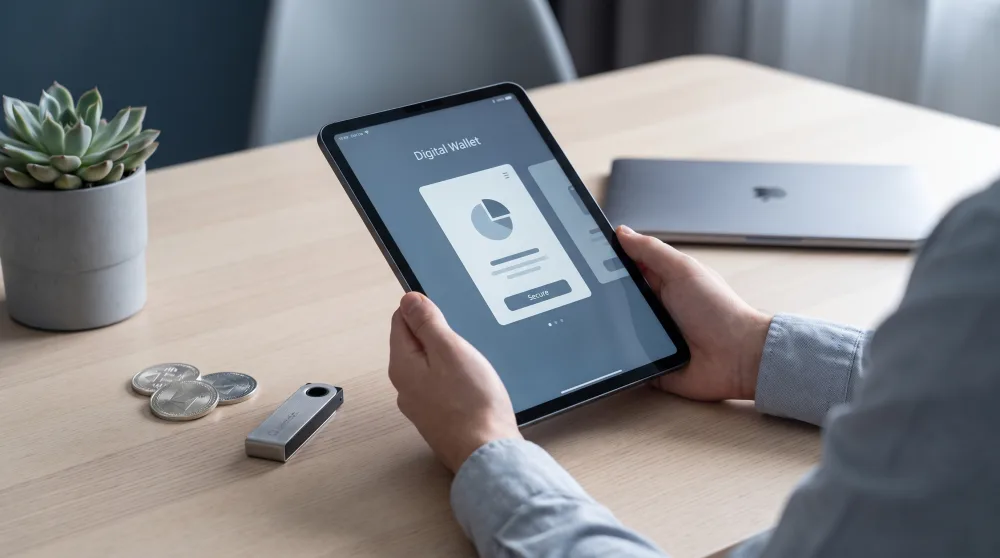
For small amounts, keeping crypto on the exchange is fine. But if you plan to hold a larger amount for a long time, it's worth learning about digital wallets. There are two main types:
- Hot wallets: apps on your phone or computer, like MetaMask or Trust Wallet. Convenient, but connected to the internet, so they carry some risk.
- Cold wallets: physical devices that look like USB drives, such as Ledger or Trezor. They stay offline and are the most secure option for anyone storing significant value. They cost between $60 and $150, so they only make sense if you're holding more than that amount in crypto.
With any wallet, you'll receive a recovery phrase — a sequence of 12 or 24 words in English. Write it down on paper, store it somewhere safe, and never, ever share it with anyone. That phrase gives complete access to your crypto. If someone asks you for it, it's a scam, guaranteed.
How much to put in — and how to think about it
Crypto is a high-risk asset. Prices swing wildly, and there's no way to predict when they'll go up or down. Financial professionals typically suggest that crypto make up no more than 5% to 10% of your investment portfolio — and only after you already have an emergency fund and safer investments in place, like index funds or bonds.
If you've never invested before, crypto isn't the best starting point. But if you already have a solid financial foundation and want to put a small slice into something higher-risk with growth potential, Bitcoin and Ethereum are the most established options. This isn't investment advice — just context to help you think more clearly.
A strategy a lot of people use is called DCA (Dollar Cost Averaging). The idea is simple: instead of putting everything in at once and hoping it's not the worst possible moment, you invest a fixed amount every month. Say, $25 in Bitcoin on the 1st of every month. That way, you buy at different price points — sometimes high, sometimes low — and build up an average entry price over time.
Do I have to report crypto on my taxes?
Yes. The IRS requires you to report cryptocurrency, and any gains from selling it are generally subject to capital gains tax. A lot of people ignore this and end up in trouble later. If you're unsure how it applies to your situation, talk to a tax professional.
What to do right now
If this topic sparked your curiosity, the next step is simple: open an account on Coinbase or another reputable exchange, deposit $20 or $30, and buy a tiny fraction of Bitcoin just to see how it feels. Watch the value go up and down. Get comfortable with that volatility before you put in any real money. Read up on the subject from reliable sources, stay away from groups promising easy money, and be suspicious of anything that sounds too good to be true. Because in the world of crypto, when something sounds too good to be true, it almost always is a scam.